

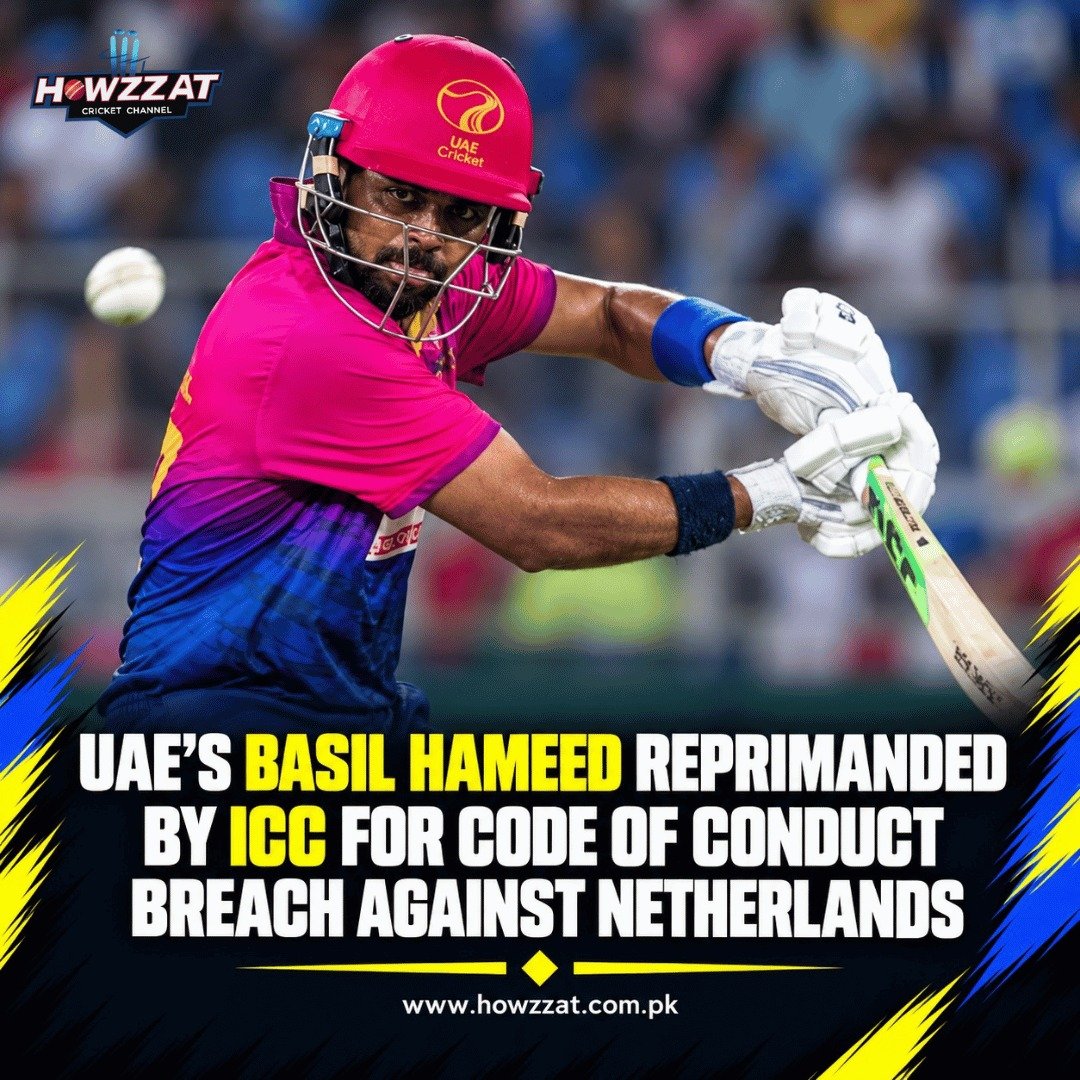
United Arab Emirates (UAE) all-rounder Basil Hameed has received an official reprimand from the International Cricket Council (ICC) for breaching its Code of Conduct during the ICC Men’s Cricket World Cup League 2 match against the Netherlands in Dubai on Sunday, October 25, 2026.
The ICC confirmed the disciplinary action on October 26, stating that Hameed had committed a Level 1 offence under Article 2.3 of the ICC Code of Conduct for Players and Player Support Personnel. The article relates to the use of an audible obscenity during an international match.
In addition to the reprimand, one demerit point has been added to Hameed’s disciplinary record. The incident occurred during the ninth over of the Netherlands’ innings, when the UAE all-rounder reacted in frustration after a catch was dropped off his bowling.
Hameed admitted the offence and accepted the sanction proposed by match referee Phil Whitticase, meaning a formal hearing was unnecessary.
What Happened During the UAE vs Netherlands Match?
The incident took place during the Netherlands’ run chase in the Cricket World Cup League 2 fixture in Dubai.
Hameed was bowling when a catch off his delivery was dropped by a UAE fielder. Frustrated by the missed opportunity, the all-rounder uttered an audible obscenity, which led to the ICC disciplinary charge.
On-field umpires Akbar Ali and Virender Sharma, alongside reserve umpire Shiju Sam, brought the charge against the UAE player.
The ICC subsequently determined that Hameed had breached Article 2.3 of its Code of Conduct. The provision addresses the use of audible obscenities during international matches and forms part of the regulations designed to maintain appropriate standards of player behaviour.
Although the incident did not result in a suspension, the official reprimand and demerit point will remain part of Hameed’s disciplinary record.
ICC Confirms Level 1 Code of Conduct Violation
The ICC categorised Hameed’s offence as a Level 1 breach, the lowest level under its player disciplinary framework.
Level 1 violations can result in an official reprimand, a fine of up to 50 per cent of a player’s match fee, and one or two demerit points. The precise sanction depends on the nature of the offence and the applicable disciplinary provisions.
In Hameed’s case, the ICC imposed an official reprimand and one demerit point. According to the governing body, this was his first offence during the preceding 24-month period.
The acceptance of the proposed sanction also meant the matter could be resolved without a formal hearing. Such procedures allow disciplinary cases to be concluded efficiently when a player admits the offence and accepts the penalty.
The ruling serves as a reminder that international players are expected to maintain professional standards even during moments of frustration on the field.
How Demerit Points Affect Players
Demerit points are used by the ICC to track disciplinary offences committed by players and player support personnel over a rolling 24-month period.
Under the system, a player who accumulates four or more demerit points within that period has those points converted into suspension points. The resulting suspension depends on the number of suspension points accumulated and the format in which the player competes.
Two suspension points result in a ban from one Test match or two One Day Internationals (ODIs) or two T20 Internationals (T20Is), whichever comes first for the player.
Hameed’s single demerit point does not automatically lead to a suspension. However, it adds to his disciplinary record and could become relevant if further offences occur within the applicable period.
Demerit points remain on a player’s record for 24 months from the date they are imposed, after which they are removed.
The system aims to discourage repeated misconduct and encourage players to respect the spirit and regulations of international cricket.
Netherlands Defeat UAE Despite Hosts Posting 244
The disciplinary incident came during a match in which the UAE suffered a defeat against the Netherlands in the Cricket World Cup League 2 competition.
Batting first, the UAE posted 244/8 in their allotted overs, establishing a competitive total. However, the Netherlands successfully chased the target, winning by three wickets with 37 balls remaining.
The result was an important outcome in the ongoing League 2 campaign, where teams are competing for valuable points in the qualification pathway towards the ICC Men’s Cricket World Cup 2027.
For the UAE, the defeat highlighted the importance of converting promising positions into match-winning performances. Dropped catches and missed opportunities can prove costly in limited-overs cricket, particularly when the opposition is chasing a challenging target.
The Netherlands, meanwhile, demonstrated their ability to complete the chase despite losing wickets along the way.
What’s Next for Basil Hameed and the UAE?
Hameed will be expected to move forward from the incident while continuing his international commitments with the UAE. The reprimand does not itself impose a suspension, allowing him to remain available for selection unless other circumstances affect his participation.
For the UAE team, maintaining discipline and improving consistency will be important as the Cricket World Cup League 2 campaign continues. Every fixture carries significance in the race to secure a stronger position in the qualification standings.
The ICC’s decision reinforces the importance of player conduct alongside on-field performance. While competitive cricket naturally involves pressure and disappointment, players are expected to manage their reactions within the boundaries of the game’s regulations.
Follow Howzzat for the latest UAE cricket news, ICC disciplinary updates, Cricket World Cup League 2 results and international cricket coverage.