

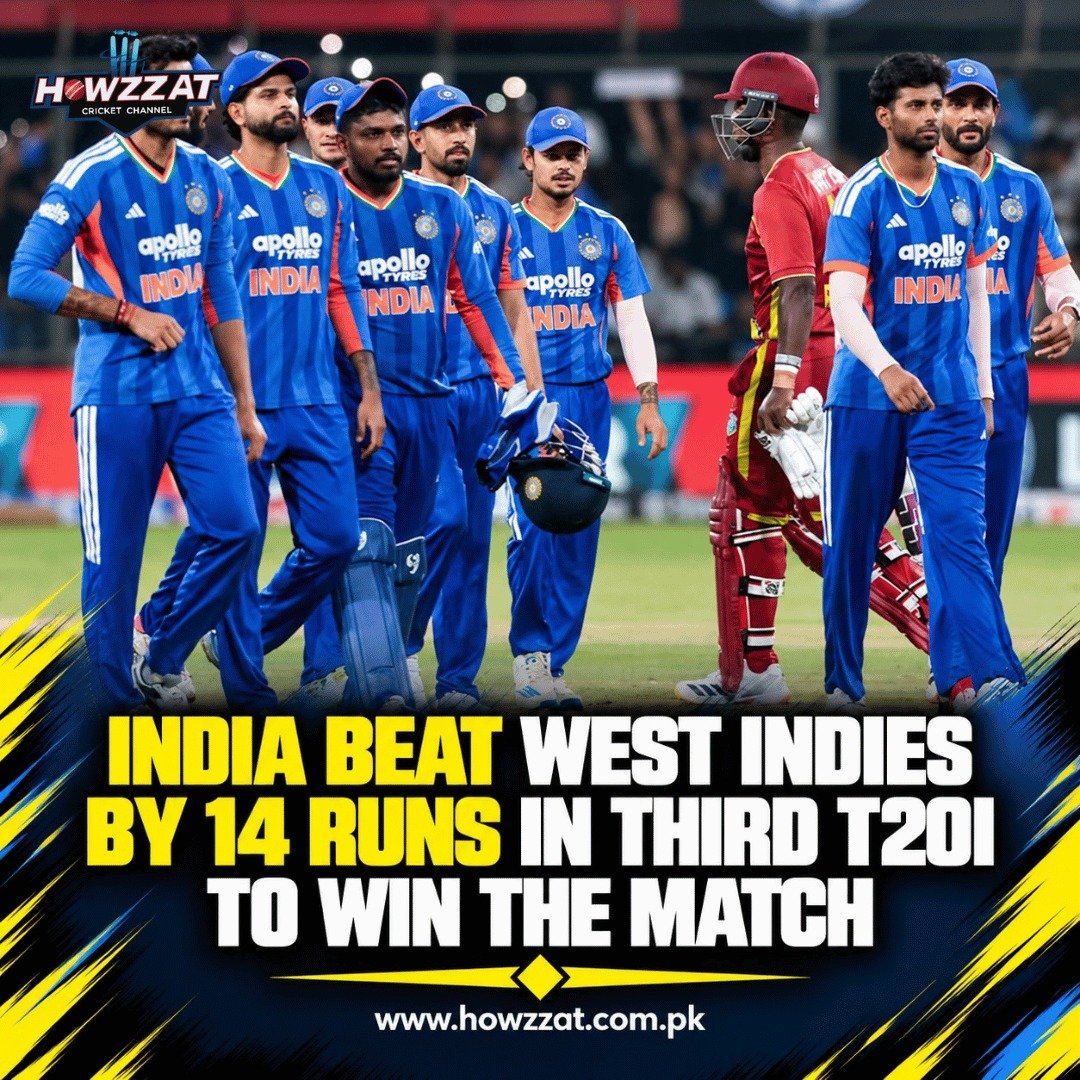
India produced a strong all-round performance to defeat West Indies by 14 runs in the third T20 International (T20I) at Holkar Stadium in Indore on Sunday, October 11, 2026. The victory restored India’s lead in the five-match series, putting the hosts ahead 2–1 after three matches.
Batting first, India posted 223 all out in 20 overs, powered by an explosive innings from Abhishek Sharma. West Indies responded with an aggressive chase but finished on 209/7, falling short despite several important contributions from their middle order and a late burst of hitting.
Arshdeep Singh played a decisive role with the ball, taking three wickets to help India defend their total. The result was particularly important for the hosts after West Indies had levelled the series with a six-wicket victory in the second T20I in Ranchi.
Abhishek Sharma Leads India’s Batting Charge
The India vs West Indies 3rd T20I began with the visitors winning the toss and choosing to field. India lost Sanju Samson early, but Abhishek Sharma responded with an outstanding display of aggressive batting.
Abhishek scored 69 off just 30 deliveries, striking six fours and five sixes. His innings gave India the momentum they needed during the powerplay and middle overs, putting pressure on the West Indies bowlers from the outset.
He reached his half-century in only 18 balls, underlining his ability to change the course of a T20 match in a short period. During the innings, Abhishek also crossed 2,000 runs in T20 internationals, adding a significant personal milestone to his performance.
Ishan Kishan supported him with 37 off 18 balls. The pair combined for a rapid 108-run second-wicket partnership, helping India recover from the early loss and build a strong platform.
Their partnership ended when Kishan was dismissed, followed by Abhishek’s departure. Tilak Varma then contributed 28 off 16 deliveries, while Nitish Kumar Reddy and Axar Patel added 21 and 20 respectively.
India eventually finished on 223 all out. Although the hosts lost wickets towards the end of their innings, their aggressive start gave the bowling attack a competitive total to defend.
West Indies Fight Back During the Chase
West Indies needed 224 runs to win and started their chase with the intention of maintaining a challenging scoring rate. However, Arshdeep Singh struck early by dismissing captain Shai Hope, giving India an important breakthrough.
The visitors continued to attack, with Shimron Hetmyer and Nicholas Pooran providing the main resistance during the middle overs. Hetmyer scored 43, while Pooran made 42, keeping West Indies in contention as the required run rate increased.
Their contributions helped revive the chase, but India continued to search for wickets rather than allowing the batters to settle completely.
Naman Dhir proved influential with the ball, taking two wickets for 39 runs. His dismissals of Hetmyer and Pooran disrupted the visitors’ progress and increased the pressure on the lower order.
Despite losing wickets, West Indies remained dangerous because of their ability to score boundaries quickly. Their chase required a strong finish, leaving the result uncertain as the match approached its closing overs.
Arshdeep Singh Delivers at the Crucial Stage
Arshdeep Singh’s three-wicket haul was central to India’s victory. He finished with figures of 3/44, providing important breakthroughs at different stages of the innings.
His impact became particularly significant during the closing overs, when West Indies were attempting to turn a difficult chase into a possible victory. Arshdeep dismissed Keemo Paul and Sherfane Rutherford in the 18th over, dealing a major blow to the visitors’ hopes.
Shamar Springer produced a late assault, scoring an unbeaten 35 off just 11 balls. His powerful hitting briefly raised the pressure on India, but the target remained beyond West Indies’ reach.
The visitors ended on 209/7 in their allotted 20 overs, 14 runs short of India’s total.
India’s bowlers showed greater composure than they had in the previous match, when West Indies successfully chased 250 in Ranchi. This time, the hosts managed to take crucial wickets and maintain control during the decisive moments.
India vs West Indies 3rd T20I: Series Standings
The result gave India a 2–1 advantage in the five-match T20I series. After winning the opening match in Lucknow by eight wickets, India had suffered a six-wicket defeat in the second game, allowing West Indies to draw level.
The third match was therefore an important opportunity for India to regain the lead, and the team’s performance with both bat and ball delivered the desired result.
Captain Shreyas Iyer will be encouraged by Abhishek’s explosive batting and the bowling unit’s response under pressure. However, India’s lower-order collapse remains an area to examine before the next match.
West Indies, meanwhile, will take confidence from their aggressive batting approach. Hetmyer, Pooran and Springer demonstrated that the team could threaten India’s total, although the loss of wickets at crucial moments proved costly.
What Comes Next for Both Teams?
The fourth T20I is scheduled for October 14, 2026, at the Rajiv Gandhi International Stadium in Hyderabad. With India leading the series, the next match offers the hosts an opportunity to move within one victory of securing the series.
West Indies will aim to bounce back and level the contest once again. Their batting lineup has demonstrated its ability to chase large targets, but the team will need a more consistent performance across the full 20 overs.
For India, maintaining the balance between aggressive batting and disciplined bowling will be essential. Abhishek Sharma’s form and Arshdeep Singh’s ability to deliver under pressure could remain important factors in the remaining matches.
The third T20I showed how quickly a high-scoring match can change direction. India ultimately held their nerve, defended 223 and earned a valuable victory in Indore.
Follow Howzzat for the latest cricket news, India vs West Indies match reports, T20I updates and performances from international cricket.